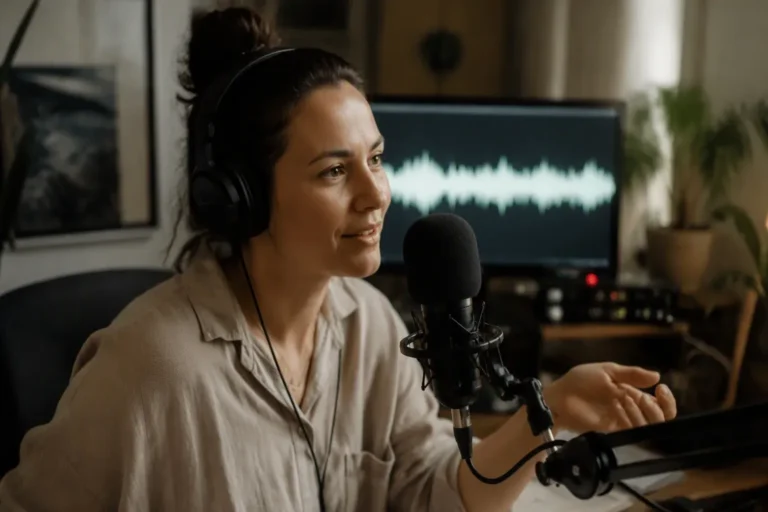
Here’s something that snuck up on all of us: while everyone was busy arguing about chatbots, AI audio quietly became production-ready. Voices that pass for human. Songs with convincing vocals, generated from a single sentence. Cloned singing voices licensed from real artists. The tools exist, they work, and they cost less than a single hour of studio time. Wild, right? Three platforms lead their respective niches: ElevenLabs for speech, Suno for songs, Kits for music production voices. Now, comparing them head to head is slightly unfair (they do different things), so instead of forcing a cage match, we mapped the territory. Here’s who should use what, and why.
Key takeaways
- ElevenLabs owns speech: narration, cloning and multilingual dubbing.
- Suno generates complete songs with vocals from a prompt, ideal for content music.
- Kits serves musicians with licensed voice conversion inside real production workflows.
- Commercial rights come with paid tiers everywhere; verify the terms before releasing.
- Fifteen dollars a month covers both voiceover and music for most creators.
ElevenLabs: the voice standard
Type text, get speech that listeners mistake for a recording. That’s the pitch, and honestly, it undersells it. ElevenLabs’ voices carry breath, pacing and emotion with a naturalness competitors are still chasing. The platform has grown into a full audio suite: professional voice cloning from longer samples, dubbing that translates videos while preserving the speaker’s vocal character across thirty languages, sound effects generation, and a long-form Projects mode built for audiobooks.
In our testing, the strengths are realism and the dubbing pipeline. The weaknesses? Price at volume, and an occasional over-smoothness, where a voice sounds suspiciously perfect for the content (like a narrator who’s had exactly the right amount of coffee). For narration, voiceover, accessibility and content localization, it’s the default choice against which everything else gets measured.
Suno: songs from a sentence
Suno remains mildly astonishing, and I don’t use that word lightly. Describe “an upbeat French pop song about missing the last train,” and ninety seconds later you have a complete track: melody, arrangement, production, and vocals with lyrics it wrote itself. Custom mode accepts your own lyrics and style steering. The output quality has crossed the threshold where background music for videos, podcasts and social content is simply a solved problem at $10 a month.
The limits matter for serious musicians, though. Arrangements are competent rather than distinctive, stems are limited, and you’re directing, not producing. For content creators and marketers who need music that exists, sounds good and clears rights on paid plans? Transformative. For artists? It’s a sketchbook, not a studio.
Kits.AI: the musician’s toolkit
Kits aims at producers, not prompters, and that distinction shapes everything about it. The core is voice conversion: sing a line, hear it in a different voice, chosen from a library of artist voices who are actually licensed and compensated. In an industry with a, shall we say, complicated relationship with consent, that ethical stance stands out. Clone your own voice for harmonies you can’t sing, convert a hummed idea into a lead vocal, separate stems, master the result. The workflow respects how music is actually made, exporting cleanly into any DAW.
Where Suno generates the whole song, Kits gives you components and control. The learning curve is steeper and the output is only as good as your production. For its audience, that’s precisely the point.
Rights and licensing: the part everyone skips
All three grant commercial usage on paid tiers, with different textures. ElevenLabs licenses your generated audio broadly. Suno’s paid plans cover commercial use of your songs, though streaming platforms and distributors are writing their own AI policies in real time, so check before release. Kits’ artist-licensed voices come with clear terms tied to the specific voice. The constant across all three: read the current terms, because this corner of the market updates quarterly. Boring homework, cheaper than a takedown.
Price compared
ElevenLabs starts free, then $5 for Starter and $22 for Creator, scaling with characters. Suno offers daily free credits, then $10 Pro and $30 Premier. Kits starts around $10 with a free tier for experimentation. And here’s the math that makes creators smile: an ElevenLabs Starter plus Suno Pro combination at $15 a month covers both voiceover and music for most people. Fifteen bucks. For what used to require a studio booking.
The combinations professionals actually run
Real audio projects rarely live inside one platform, so the useful question is how these tools chain together. Video with narration and music? ElevenLabs for the voiceover, Suno for a custom background track no stock library licenses awkwardly, assembled in your editor. Podcast with an intro? Kits or Suno for the theme, ElevenLabs for voiced promos or translated episode versions. Music production with topline experimentation? Hum into Kits, convert to a reference vocal, produce around it.
Two practical notes from production experience. First, keep a consistent voice across a series: save your chosen ElevenLabs voice ID and settings, because audiences absolutely notice narration drift between episodes. Second, mind loudness and mastering: AI music arrives unmastered, and even a free automated mastering pass closes most of the gap with library tracks. The tools solved generation. The remaining craft is assembly and consistency, which is good news, because craft is learnable.
A word on disclosure, because audio raises the stakes. Synthetic voices realistic enough to deceive create obligations the law is beginning to formalize: several jurisdictions now require labeling of synthetic media in political and commercial contexts. The safe professional practice is simple: label AI-generated audio wherever a listener might reasonably assume otherwise, get consent before cloning any voice but your own, and keep records of your licenses. The creators building durable audiences treat disclosure as trust infrastructure, and their audience data supports them.
How we tested. Identical scripts voiced across platforms, identical song briefs generated and rated blind by musician and non-musician listeners, and full workflow tests from brief to exported audio. We pay for our own accounts. Protocol on our methodology page.
The bottom line
So where do you start? Podcasters, video creators, e-learning teams: ElevenLabs, full stop. Content creators needing music: Suno, today. Producers and musicians: Kits, with Suno as an idea generator upstream. Remember that studio hour these tools undercut? It’s now fifteen dollars and an afternoon of experimentation. And if you’re building the visual half of synthetic media too, our Synthesia vs HeyGen avatar comparison has you covered. Go make some noise.